

Key Takeaways
- Commercial stone cladding gives commercial buildings a premium stone appearance with less weight, cost, and maintenance than traditional full-bed masonry.
- Natural stone cladding and manufactured stone veneer support durable exterior walls, code-conscious building facades, and long-term durability.
- Stone cladding delivers timeless beauty, thermal performance, and strong resistance to rain, sunlight, freeze-thaw cycles, and daily wear.
- Quarra Stone has supported high-performance natural stone solutions for complex commercial projects across North America since the 1990s.
- This guide covers design options, installation, building codes, and practical project inspiration for architects, contractors, and owners.
Introduction: Why Stone Cladding Matters for Modern Commercial Buildings
Stone cladding is thin natural stone or stone veneer attached to structural walls, not load-bearing stone masonry. Since the early 2000s, it has become a standard choice for offices, universities, civic buildings, hospitals, museums, and mixed-use buildings because it reduces weight while preserving depth, texture, and permanence. Traditional stone walls may be many inches thick; modern cladding often uses thinner pieces, anchors, rails, or panelized systems. Commercial stone cladding materials are classified into natural stone and engineered/manufactured veneers, each offering unique performance metrics for commercial facades. Asymmetric Applications produced this guide for Quarra Stone, a project partner for sophisticated commercial stone facades rather than a generic material supplier.
Core Benefits of Stone Cladding for Commercial Buildings
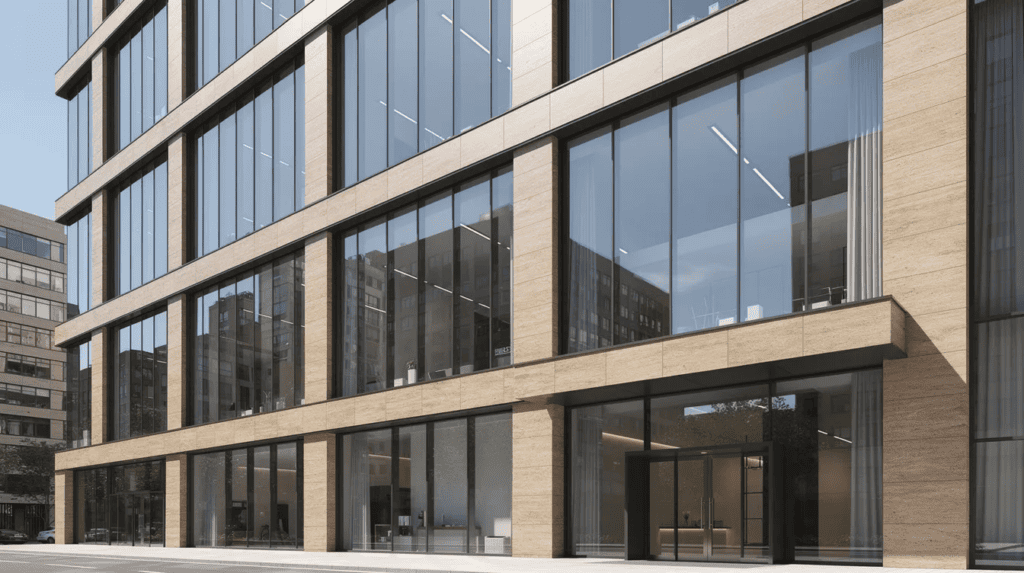
For owners, developers, and design teams, commercial stone cladding provides buildings with exceptional durability, a timeless aesthetic, and enhanced thermal performance.
- Aesthetics: natural variation, unique textures, colors, and veining add depth and enhance brand image for headquarters, hotels, and institutional exteriors.
- Performance: commercial stone cladding can withstand severe rain, freeze-thaw cycles, and prolonged sunlight without fading.
- Efficiency: stone cladding enhances energy efficiency by adding thermal mass, helping to reduce heating and cooling costs.
- Practical value: thin cladding lowers dead load versus full-bed stone, works with modern wall assemblies, and can shorten commercial project timelines.
- ROI: When installed correctly, stone veneer provides a durable, low-maintenance facade solution that maintains its appearance over time while reducing long-term upkeep costs.
Natural Stone Cladding vs. Manufactured Stone Veneer
Both options are suitable, but the right choice depends on budget, vision, performance, and desired architectural style.
- Natural stone cladding is thin-cut stone, such as limestone, granite, marble, or sandstone, anchored to exterior walls or interior backing walls. Granite is the hardest and least porous stone option, offering exceptional scratch, frost, and UV resistance.
- Manufactured stone veneer is a cement-based or polymer-modified manufactured material molded to resemble natural stone. Stone veneer offers the appearance of natural stone while being lightweight, which reduces structural requirements and expands the range of surfaces where it can be applied.
- Appearance: natural stone has authentic variation and character; manufactured veneer uses repeated profiles that may feel less deep up close.
- Cost: stone veneer typically costs less than natural stone due to reduced material weight, faster installation, and lower labor requirements, making it attractive for large-scale commercial projects without sacrificing visual impact.
- Use case: Quarra Stone focuses on premium stone veneer and precision natural stone cladding where authenticity, compliance, and life-cycle value matter most.
Design Applications: Exterior Walls and Interior Spaces
Stone veneer is widely used in commercial architecture for both interior and exterior applications, enhancing the visual appeal and durability of spaces such as offices, retail stores, and hospitality venues.
- Exteriors: use cladding on full building facades, podiums, entry portals, columns, canopies, and low-level impact zones. Natural stones like granite should be used for base-level storefronts to withstand heavy pedestrian impact over the first 10 feet of a commercial facade.
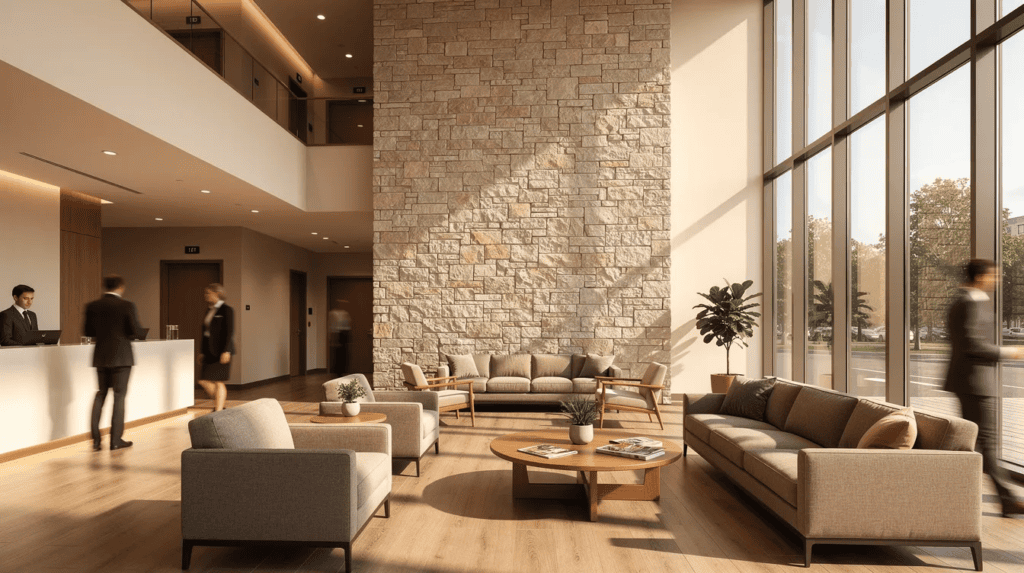
- Interior: create lobby feature walls, elevator cores, reception desks, atrium surrounds, retail focal walls, bars, and fireplace surrounds.
- Flexibility: stone veneer is available in a wide range of profiles, from rugged ledgestone to uniform contemporary styles, allowing designers to align the material with the overall architectural vision of a project.
- Creativity: the ability to mix and match styles and colors in stone veneer opens the door to creative expression, enabling each project to feel unique and tailored to specific design goals.
- Continuity: matching exterior spaces and interior finishes can create a seamless brand experience from plaza to lobby.
Meeting Building Codes and Performance Requirements
Commercial cladding must be engineered, not improvised. Stone cladding offers excellent non-combustible properties to enhance structural safety compliance, especially on taller building exteriors. Teams must account for wind loads, seismic movement, anchor design, curtain wall coordination, steel frame movement, and concrete structure tolerances. Moisture measures matter: continuous air-water barriers, drainage, flashing, and ventilated cavities protect the assembly. Commercial exterior projects must verify architectural stones using specific testing standard metrics, prioritizing materials tested under ASTM C880 for flexural strength. ASTM C1242 is also commonly referenced for dimension stone anchorage guidance. Quarra Stone works with architects, engineers, and contractors through design development and shop drawings, so compliance is planned early.
Installation and Detailing Considerations for Commercial Projects
Installation determines whether the stone performs for decades.
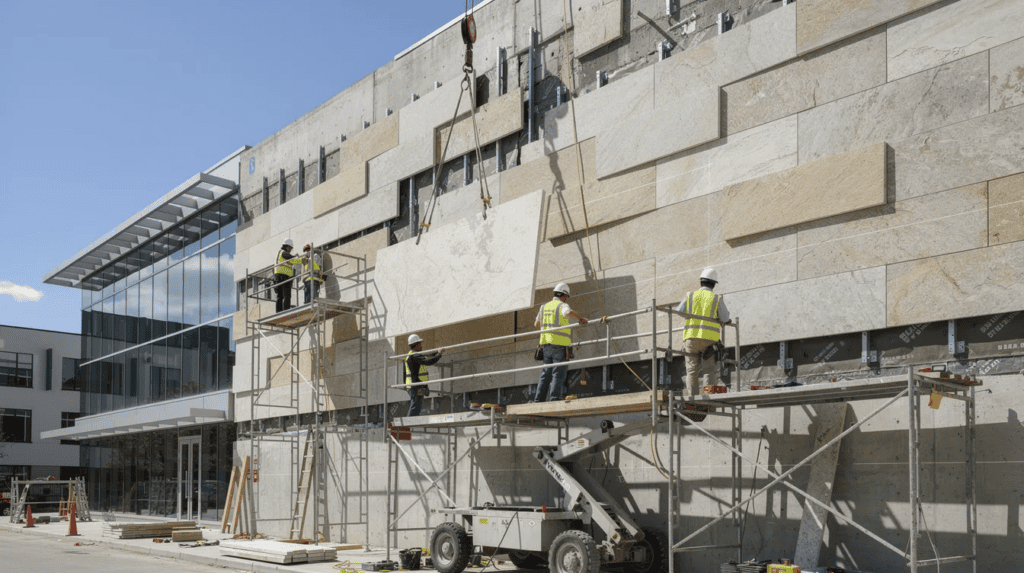
- Systems: natural stone cladding may use handset anchors, kerf supports, unitized curtain wall integration, mechanically fixed stone veneer systems, or panelized assemblies.
- Substrates: concrete, masonry, and metal stud walls need appropriate sheathing, structure, and air-water barriers.
- Scheduling: stone veneer can be installed as individual pieces or in panelized systems, offering flexibility in both design and construction, making it suitable for new builds as well as renovations.
- Cost efficiency: the lower weight of stone veneer reduces transportation and structural costs, contributing to overall cost efficiency in commercial construction.
- Schedule control: faster installation timelines for stone veneer help keep commercial projects on schedule, which is especially important in construction, where delays can lead to significant financial impact.
- Quality: mockups, samples, joint reviews, and anchor inspections protect both appearance and performance.
Working with Quarra Stone on Commercial Stone Cladding
Quarra Stone supports complex commercial and institutional facades across North America with a practical, collaborative process.
- Sourcing: high-quality natural stone selected for performance, color consistency, and environment.
- Fabrication: CNC technology delivers precise pieces, custom profiles, and installation-ready products.
- Collaboration: Quarra assists with material selection, mockups, shop drawings, façade engineering coordination, and installer communication.
- Scale: the team supports large orders, demanding tolerances, and tight commercial schedules.
- Confidence: early engagement helps align stone selection, budget, details, and future maintenance expectations.
Project Inspiration: How Commercial Buildings Use Stone Cladding
A corporate headquarters can use honed limestone or granite on primary building facades to stand for stability, professionalism, and permanence.
A university science building or civic hall can use natural stone cladding around an entry plaza to complement historic campus walls while expressing a modern style.
A mixed-use hotel can use stone veneer at storefronts, signage bands, and corner columns to elevate pedestrian appeal and attract customers.
Healthcare and hospitality interiors can use warm stone to create calm, durable spaces where every person feels a sense of quality. Designers can also explore pools, restaurants, residential amenity areas, and outdoor rooms for additional inspiration.
Long-Term Maintenance, Cost Efficiency, and ROI
Stone does not rot, fade, or easily deteriorate, requiring minimal upkeep over its lifespan compared to painted walls or siding. The durability of stone veneer makes it suitable for high-traffic commercial environments, as it can withstand weather exposure, temperature fluctuations, and daily wear without significant deterioration. Regular inspection and gentle cleaning methods are recommended to maintain the appearance and performance of stone veneer in commercial settings, avoiding harsh chemicals that could damage the surface. For asset managers, stone can preserve perceived value, support rental rates, and influence tenant or customer behavior in retail and hospitality settings. For more resources, articles, and programs on commercial stone, Quarra Stone can help match the right choice to your project.
FAQ: Commercial Stone Cladding
How thick is commercial natural stone cladding compared to traditional stone masonry?
Modern cladding is often roughly 1–2 inches thick, depending on stone type, anchoring, and engineering. Traditional load-bearing stone masonry is much thicker. The reduced thickness lowers structural weight while preserving visual depth.
Can commercial stone cladding be used on existing commercial buildings during renovation?
Yes. Stone veneer and natural stone cladding can refresh older facades if engineers verify substrate capacity, anchorage, and moisture conditions. Early consultation with Quarra Stone helps define feasibility and suitable materials.
Does stone cladding improve a building’s energy performance?
Stone is not the main insulation layer, but it adds thermal mass and protects the wall from temperature swings and solar exposure. Final energy performance depends on the complete assembly.
How long does a commercial stone cladding façade typically last?
Properly detailed natural stone cladding can last for many decades and often match the building’s service life. Longevity depends on stone selection, climate, detailing, and routine maintenance.
When should I involve a stone specialist in my commercial project?
Bring in a stone specialist during schematic design. Early input can optimize panel sizes, joints, anchoring, budget, and schedule before changes become expensive.
