


Key Takeways
- Vals quartzite, also called Valser quartzite, is a rare mica quartzite from the Swiss Alps, prized in contemporary architecture for durability, visual impact, and natural beauty.
- The stone formed more than 250 million years ago; it is naturally frost-resistant and suitable for demanding interior and exterior applications worldwide.
- Peter Zumthor’s 1996 Therme Vals made Vals quartzite architecture famous by showing how one natural stone can define an entire architectural language.
- Quarra Stone helps architects source, engineer, and fabricate quartzite slabs, wall panels, pavers, and custom elements for North American design projects.
- This guide answers practical questions on performance, maintenance, sustainability, and how to use Vals stone in landmark architectural and design projects.
The Origin and Geology of Vals Quartzite
Vals Quartzite is quarried in the Vals valley near Vals Platz, Graubünden, where the limited quarry area gives this Swiss stone unusual provenance. In shorthand, the Swiss Alps describes more than a place: quartz-rich sandstone was transformed by extreme heat, pressure, and tectonic folding over millions of years into dense quartzite. Dominant quartz, mica, and minor feldspar create subtle, layered silvery-green tones, cool greys, warmer greens, and white veining. High mica content gives cut, polished, and honed surfaces distinctive reflective qualities, while tectonic banding reads like pages in a geological history book. Vals Quartzite has a low porosity of 0.8% and a high density of 2730 kg/m3, contributing to resistance to water, frost, and erosion.
What Makes Vals Quartzite Architecturally Distinct
The immediate aesthetic appeal of Vals quartzite is quiet and monolithic rather than decorative. It is a versatile natural stone with a distinct fine veined texture, and a subtle shimmer that separates it from crystalline granite or dramatic marble. Cut orientation changes the mood: vein cuts emphasize veining and strata; fleuri cuts create a calmer field. A surface finish such as honed, brushed, sandblasted, flamed, split-face textures, or polished changes light from metallic sparkle to deep shadow. This range makes Vals quartzite suitable for minimal modern architecture and traditional designs. What makes Vals quartzite especially architectural is its refined beauty, natural strength, density, and timeless appeal.
Vals Quartzite in Landmark Architecture
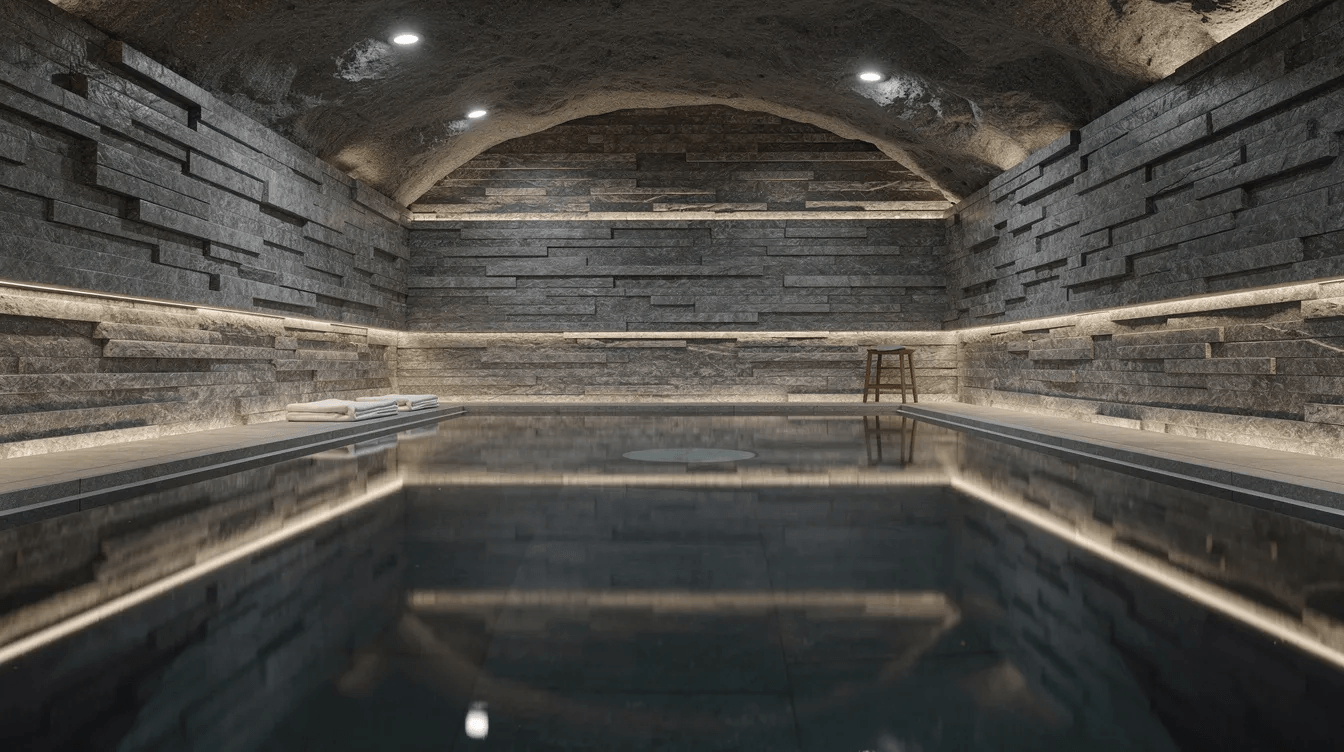
Therme Vals, designed by Pritzker Prize-winning architect Peter Zumthor and completed in 1996, remains the most iconic example of Vals quartzite architecture. The spa is embedded in the mountain, built with load-bearing blocks and slab elements of valser quartzite laid in horizontal strata, evoking a man-made quarry and primordial cavern. Here, vals quartzite acts as a spatial and structural unifier, shaping walls, roofs, pools, thresholds, and light slots. The stone is prized for exceptional durability, monolithic aesthetic, and unparalleled sensory interaction with light and water. Today, it is a highly sought-after, durable Swiss stone emphasized in several iconic structures around the world.
Performance: Durability, Weathering, and Maintenance
Vals Quartzite is specified for landmark work because it performs for decades. The stone has a dense, interlocking crystalline structure that makes it highly resistant to abrasion, freeze-thaw cycles, and heavy foot traffic. Its crystalline structure, formed under extreme heat and pressure over millions of years, ensures a long service life. The stone is known for its low porosity, with a water absorption rate of only 0.8%, which contributes to durability and resistance to water damage. Vals Quartzite is frost-resistant and can withstand harsh weather conditions, making it suitable for both interior and exterior applications. As the stone continues to weather, color softens into patina rather than failure. Maintenance is straightforward: pH-neutral cleaning, optional sealing for countertops, and occasional reconditioning in high-use paving.
Design Applications: From Façades to Kitchens
Vals Quartzite is utilized in modern architecture for façades, paving, cladding, feature walls, pool surrounds, and luxury interiors, showcasing its versatility across various applications. Vals quartzite is favored for exterior rainscreens and claddings due to its low porosity, which protects against harsh weathering. It is used for exterior cladding, facades, wall cladding, wall panels, pavers, stairs, benches, retaining walls, and landscape design. Due to its hardness and resistance to erosion, Vals quartzite is frequently utilized in urban and institutional applications, such as city plazas and transit hubs. Its low porosity and strong resistance to water and frost make it particularly suitable for wet environments, such as spa and pool settings, where it enhances both safety and aesthetics. For interior uses, Vals quartzite’s resistance to acid, scratches, and heat makes it a high-end choice for kitchen countertops, bathroom vanities, and indoor/outdoor fireplace surrounds. In kitchens, its hardness and refined look suit countertops and islands that need daily resilience.
Working with Vals Quartzite: From Quarry to Fabrication
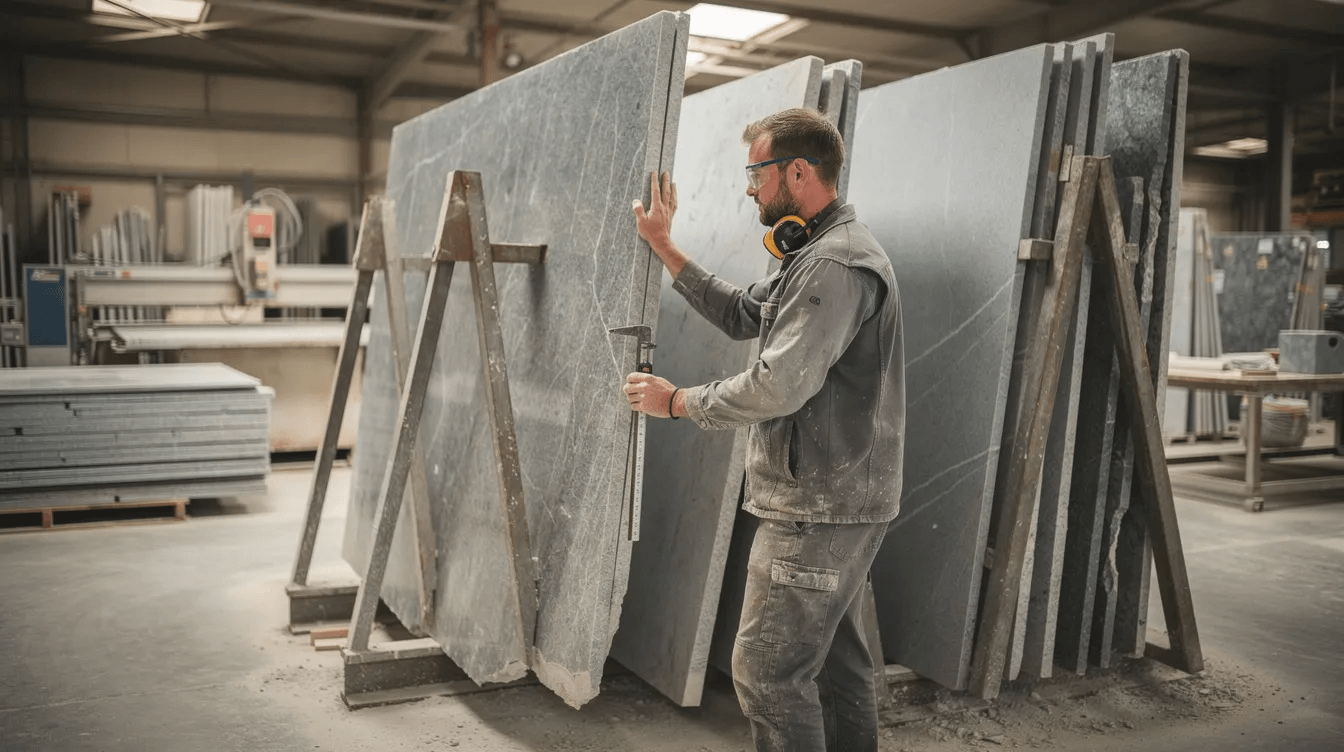
From quarry to finished architecture, Vals quartzite requires experienced coordination. Blocks from truffer ag can become quartzite slabs, tiles, large-format paving, custom slab pieces, or carved elements. Cut direction, thickness, anchoring, and surface finish should be coordinated early with engineers and façade consultants, especially for exterior applications and commercial projects. CNC fabrication and hand finishing help achieve tight tolerances for returns, reveals, drip edges, and complex corners. Lead times can span months because quarry selection, mock-ups, fabrication, and shipping must align. Early planning helps architects use the stone where it has maximum visual impact and technical value.
Quarra Stone’s Approach to Vals Quartzite Projects
Asymmetric Applications presents this article for Quarra Stone, a fabrication partner helping architects realize ambitious vals quartzite architecture in North America. Quarra Stone works with genuine quarry sources, supports block selection, develops mock-ups, and advises on anchoring, jointing, panel size, and finish combinations. The goal is simple: respect the stone’s limits while preserving the architect’s design intent. For civic, cultural, hospitality, and high-end residential work, Quarra helps integrate cladding, paving, landscape, and interior elements as one material system.
Environmental and Long-Term Value Considerations
Durable natural stone can support long-life envelopes when properly detailed. Vals Quartzite is considered sustainable due to its local quarrying in Switzerland, which reduces transport distances and associated carbon emissions for regional use, while global imports require lifecycle analysis. The longevity of Vals Quartzite lowers the frequency of replacements, contributing to a reduced embodied carbon footprint over the lifecycle of a building. Vals Quartzite’s thermal mass aids in passive temperature regulation, enhancing energy efficiency in buildings where it is used. Outdoor mock-ups help teams study how specific cuts, mica shimmer, water exposure, and finishes age in nature before final approval.
FAQs: Practical Questions about Vals Quartzite in Architecture
Is Vals Quartzite suitable for very cold or coastal climates?
Yes. Vals Quartzite was proven in the Alpine climate of the Swiss Alps and is naturally frost-resistant. Its dense, low-porosity structure helps prevent water ingress and spalling, though drainage, and edge details.
How does Vals Quartzite compare to granite or marble for kitchen countertops?
Vals Quartzite offers granite-like hardness with a calmer, marble-adjacent elegance. It resists scratching and acid etching better than softer marble, but sealing, trivets, and cutting boards are still recommended for kitchen countertops.
Can Vals Quartzite be used structurally, or is it only for cladding?
Vals Quartzite can be used as cladding and, where engineering and code allow, as load-bearing stone. Thick blocks can form structural walls, steps, and landscape features; most contemporary façades use engineered anchors and substructures.
What lead time should architects plan for?
Architects should plan several months from shop drawing approval to delivery, depending on quarry capacity, formats, and finish requirements. Early reservation is important for large facades, civic plazas, and extensive exterior paving.
How can design teams compare finishes and cuts?
Start with samples showing honed, polished, sandblasted, brushed, flamed, split-faced, vein-cut, and fleuri-cut options. For landmark projects, Quarra Stone can coordinate larger mock-up panels so clients can judge light, shadow, color range, and refined surface character before final specification.
